
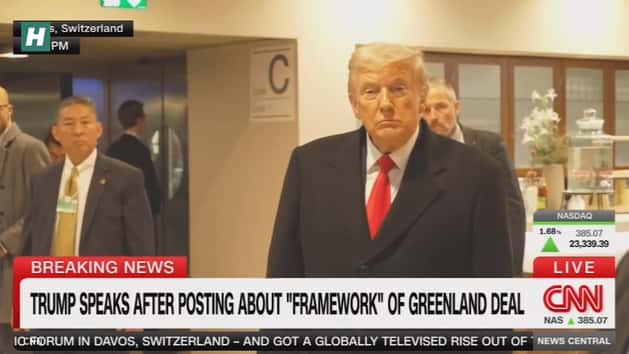
On Wednesday morning, as President Donald Trump prepared to address the World Economic Forum in Switzerland and demand that Denmark hand over Greenland to the United States, members of the Danish and U.S. foreign policy establishment gathered at a think tank in Copenhagen.
The meeting had been scheduled to discuss the transatlantic alliance before Trump ruptured it, and brought together experts advising various governments on foreign policy from their positions in think tanks. The Americans tried to lower tensions, according to Philip Bednarczyk, an American who attended the gathering and works at the German Marshall Fund’s office in Poland. He said they suggested that U.S.–European cooperation was still possible and that there was a path through the crisis, despite Trump’s threats to slap tariffs on European countries or even launch an attack to get his way on Greenland.
Some of the Danes responded by floating the idea of a version of NATO without the U.S., he said.
Though Trump backed down by the end of the day, his two weeks’ worth of assaults over Greenland have rattled European diplomatic officials like nothing in recent memory, according to several who spoke to HuffPost. (All requested anonymity because they were not authorized to speak to the press.) They said Trump sowed chaos within their governments, leading to what appears to be a permanent shift in thinking toward skepticism of the U.S.
“Even if we manage to get through this,” one said, “I don’t think it changes the general approach that the U.S. is not a reliable partner anymore.”
Earlier in the week, Trump presented U.S. control of Greenland as a foregone conclusion. One official said colleagues in their government held internal discussions about the need to abandon their past approach of dismissing the U.S. president’s bluster.
“We tended … to downplay what Trump or Vice President JD Vance said, to think that it’s posture and they don’t really mean it,” the official said. “But it became increasingly clear that they will do what they say, even what seemed too extreme or too eccentric.”
Trump’s escalating threats against Denmark dominated office chatter and group chats, with one European official witnessing “a mixture of frustration from insecurity, unpredictability and a feeling of betrayal with anger and resentment.” By the middle of the week, as senior U.S. officials mocked Europe’s ability to respond to Trump, the official said their colleagues had become sick of even talking about the U.S. relationship: They resorted to giving each other pointed looks when hearing the latest from Trump. “It’s all crazy. Batshit crazy,” they said.
The alarm blended with disappointment in their own leaders’ response. On Thursday, an E.U. official told HuffPost they compared most European countries’ approach to the president to the fable of the frog and the scorpion: Both die after the former foolishly trusts that the latter will not sting and paralyze him. The scorpion, the official noted, was at least clear about its toxic nature.
European institutions “don’t seem able to adapt to a world in which the U.S., that played such a crucial role in European integration, not to mention NATO, may actually turn into a threat,” said Nathalie Tocci, the director of the Istituto Affari Internazionali in Rome. That’s changed since the fracture over Greenland, at least among diplomats, she suggested: “Individually and privately, they all get it.”
Trump backed down only after the European Parliament suspended the U.S.-E.U. trade deal and after European officials like French President Emmanuel Macron began suggesting the E.U. might deploy its powerful “Anti-Coercion Instrument” tool, which could severely hurt American businesses by disrupting their sale of goods and services to 450 million Europeans.
Bednarczyk, the analyst, said this week led proponents of close ties with the U.S. in countries such as Germany, France, Italy and Poland to have “a painful recognition that we’re losing what we had.” He expects pro-American voices in policymaking will lose out to rising anti-American sentiment, such as in nationalist far-right political parties.
Amid the deepening rupture, some Europeans are also losing faith that the foundational ideas their alliance with the U.S. claimed to champion — human rights and fundamental global principles — are still relevant.
“The fact that the U.S. has backtracked so much [means] there’s no more rules-based order,” one official said, referencing America’s role in Israel’s atrocities in the Gaza Strip and Trump not talking about accountability for Russia over the war in Ukraine.
“The genocide in Gaza was a general rehearsal for abandoning the principles of law, humanity and respect (which were only superficial anyway, but still acted as a deterrent, albeit a weak one),” the E.U. official wrote in a message. “The experiment went well and is now being applied elsewhere, as in Venezuela, Greenland and the streets of Minneapolis. In many European countries, the same forces are trying to follow the example, and although they do not yet have sufficient strength, they are trying.”